The Making of a Race Caller: The Matt Dinerman Story
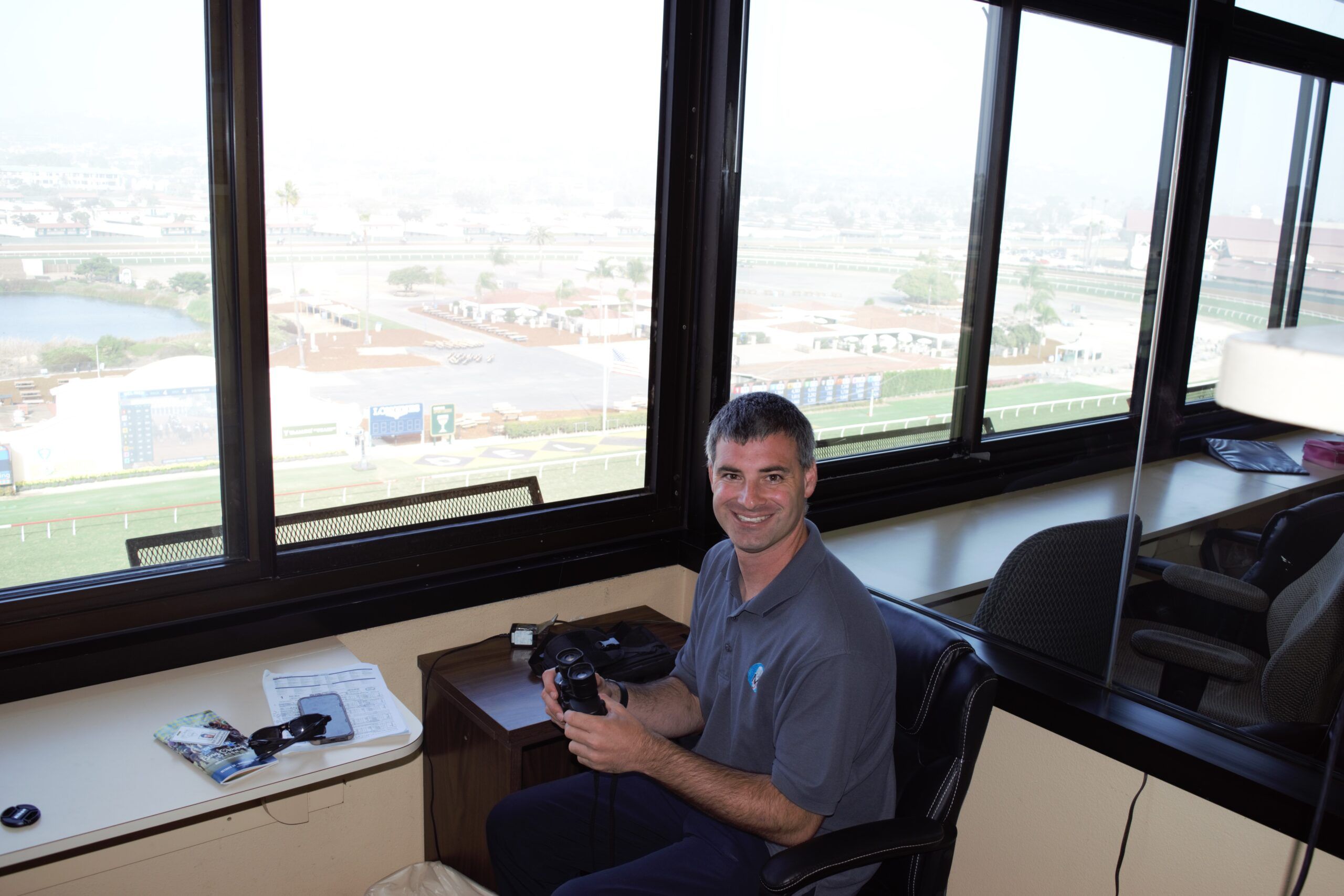
A return to the Del Mar Racetrack is a homecoming of sorts for Matt Dinerman. Long before he started calling races, he attended the Seaside Oval as a fan with his family. A lifelong San Diegan, Dinerman describes being back at Del Mar with one word: "Nostalgic."
Dinerman’s first memories here go back to when he was ten or eleven, attending races with his father. He recalls being taken aback even at a young age by the overall atmosphere of the track, the look of the horses, the tremendous speed at which they ran, and the energy of a weekend crowd. Hearing the roar of the grandstand as the field charged down the homestretch made him more invested with every return trip.
While Dinerman did not grow up in a racing family in the traditional sense, his father, David, sat on the board of Tranquility Farm, a Thoroughbred aftercare organization that rehabilitates and rehomes retired racehorses. Sensing his son’s growing interest in the sport, David reached out to their neighbor, Gayle Van Leer, a Southern California-based bloodstock agent. Through that connection, Dinerman received his first opportunity in horse racing. At the former Del Mar yearling sale, he operated one of the gates, helping show yearlings to potential buyers.
Although a small and simple task, it only deepened Dinerman’s interest. When he reached high school and became old enough to work on the backstretch, Van Leer connected him with prominent Southern California trainer John Sadler. Dinerman began by hot walking horses and spent four summers working for the Sadler barn. It was there that he learned the true ins and outs of the racing industry, particularly how a racetrack operates behind the scenes.
Dinerman, like any other kid, also had other interests. Baseball, in particular, consumed a lot of his time when he wasn't at the track. While initially having ambitions to play in college, he found himself becoming more invested in racing and ultimately decided that was where his future lay.
As Dinerman finished his high school years and moved on to college, first at Palomar Junior College in San Diego and then Chapman University in Orange, he also made a change at the racetrack. He transitioned from working on the backside with the Sadler barn to the press box, wanting to explore different avenues within the racing industry. For two summers, he worked for Del Mar’s Dan Smith as a press box steward.
While working as the press box steward, Dinerman wanted to give race calling a try. Citing legendary hockey announcer Doc Emrick as an influence, he began calling races on his own from one of the empty press boxes, with no live feed, no camera, just a pair of binoculars and his phone used as a recorder. He would practice by calling the races as they unfolded in real time.
This went on for some time until Dinerman came across a job posting from Emerald Downs Racetrack in Washington. They were looking to hire a new race announcer. Despite having zero real-world experience and armed only with his self-made tapes from Del Mar, Dinerman felt he needed to apply. He admits he didn’t feel ready, but he understood how rare announcing opportunities are in the United States and knew he couldn’t let the moment pass.
Dinerman sent in his tapes, expecting nothing to come of it. To his surprise, someone from Emerald contacted him a week later. Even though he had never been on a live microphone, he flew up to Emerald Downs and called two races as an audition. With more than 20 applicants, nearly all with more experience, Dinerman received a call the next day informing him he had gotten the job.
“I was floored. I thought they were just being nice and letting me get some exposure,” Dinerman now admits. After barely considering himself a legitimate candidate, he was suddenly officially a racing announcer. He returned to California, graduated from college, and soon after began his announcing career in the Pacific Northwest.
At just 22 years old, Dinerman became the youngest racetrack announcer in the country. He recalls it being a blessing in disguise that he was so busy and surrounded by new experiences that he didn’t have time to dwell on how anxious he was. One of the biggest things he remembers from those early days was how kind and accepting the Emerald Downs team was from day one. “They understood that here was this young guy most people had never heard of, coming in very raw, and they took me in as one of their own. That really helped.”
When asked how he developed his style of race calling, Dinerman says it’s an art, and like any artist, each caller has their own style. He began listening to tracks across the country and even international racing, picking out elements he admired and incorporating them into his own unique voice.
Dinerman remained at Emerald Downs for two and a half years, growing from a very green announcer into a savvy race-calling veteran in that time. However, because Emerald only ran part of the year, he had no announcing work for the other half of the calendar. At the urging of his father, he reached out to Joe Morris, who was then overseeing operations at Golden Gate, about potentially doing some TV handicapping. Morris was immediately receptive to the idea, and Dinerman began working as a paddock analyst in the fall of 2017. From there, the role blossomed into his next announcing opportunity when Golden Gate’s longtime caller moved on. Still in his mid-20s, Dinerman went from a college kid who had never called a race in front of a crowd to announcing at two major West Coast tracks.
Dinerman says that in his mind, it was during his second or third year at Golden Gate that he truly hit his stride. Although he gained valuable experience early on, he was only calling races half the year. Once he became Golden Gate’s full-time announcer, he was calling races year-round, allowing him to build the thousands and thousands of repetitions he believes are necessary to become truly skilled at the profession.
Things were trending upward for Dinerman as he found a comfortable and supportive home in his native California. But like many others, he was thrown for a loop when the impending closure of Golden Gate Fields was announced in July 2023. “I had put so much heart, sweat, and tears into that place, just like so many other people at Golden Gate, many who had been there much longer,” he said, reflecting on the close-knit racing community. “It was our little gem in the north.” Even today, he admits that while he’s come to terms with it, there are moments that remind him of the loss. “Every once in a while something will trigger it, and I’ll feel like it’s a shame that happened.”
Like many others in the Northern California racing community, Dinerman had to process the loss while also figuring out what came next. He describes this period as another case of impeccable timing in his career. Oaklawn was coincidentally searching for a new announcer at the same time. Although he had been content with his full-time role in California, the opportunity immediately captured his interest.
Oaklawn was already deep into its search and had narrowed the pool of candidates, but once Dinerman threw his hat into the ring, given his résumé and unique experience, he quickly became one of the top finalists. He flew out to Oaklawn shortly afterward for an interview and tour of the facilities and was offered the position the following month. After Golden Gate’s 2023 fall meet concluded, he packed his bags and headed to Arkansas.
While he knew Oaklawn had strong racing and that things seemed to be on the rise there, Dinerman admits his knowledge of Arkansas was limited before he started. Prior to visiting for his interview, he had never set foot in the state. He said he knew of Hot Springs because of the racing and Little Rock because it’s the capital and that was about it.
Despite trekking halfway across the country into the unknown, the transition was remarkably seamless for Dinerman. By then a seasoned veteran of the profession with multiple racetracks and thousands of calls under his belt, he hit the ground running in Hot Springs. As with his first stop at Emerald, the community embraced him with open arms and quickly made him one of their own.
One major change, however, was the level of races he was now calling and the atmosphere surrounding them. Going from smaller fields and a smaller horse population to being on America’s Day at the Races and calling the Arkansas Derby in front of 65,000 people was an exciting shift. While there was naturally some anxiety, he admits that after the first day he realized the million-dollar races weren’t fundamentally different from the $2,500 claiming races he called early in his career at Emerald. He simply had to prepare and rely on the same principles that had carried him to this point.
After some time at Oaklawn, it became clear that the challenge and the spotlight were not too big for Dinerman. His success there ultimately led him to his next stop: Monmouth Park Racetrack in Oceanport, New Jersey. Monmouth’s management, impressed with his body of work at Oaklawn, met with him and, after an informal dinner interview, hired him for their meet. Dinerman now announces nearly year-round, with a brief break late in the year, spending December through May in Arkansas at Oaklawn and late May through September in New Jersey at Monmouth.
Dinerman describes the experiences of the first decade-plus of his career as “surreal.” He says that if you had told him back when he was getting started at Del Mar that he would go on to accomplish all he has so far, he wouldn’t have believed it. He reflects fondly on the journey, traveling the country, pursuing his passion, calling races, and meeting new people. “It just goes to show that if you work really hard at something, if you keep at it, not only can you improve your craft, but you can improve as a person. What you think is your limit might not be your limit at all, there can be so much more you can do.”
Still only 33 years old, Dinerman is a testament to putting yourself out there and chasing your dreams because you truly never know what can happen. What began as a simple interest, going to the racetrack with his father in Southern California, has become a career that has taken him to racetracks across four different states, making him an ambassador for the sport to millions of cumulative fans both at the track and watching from home. His story serves as an inspiration to everyone in racing: with hard work, passion, and grit, there is no telling where this game can take you.